
President Abraham Lincoln with Union soldiers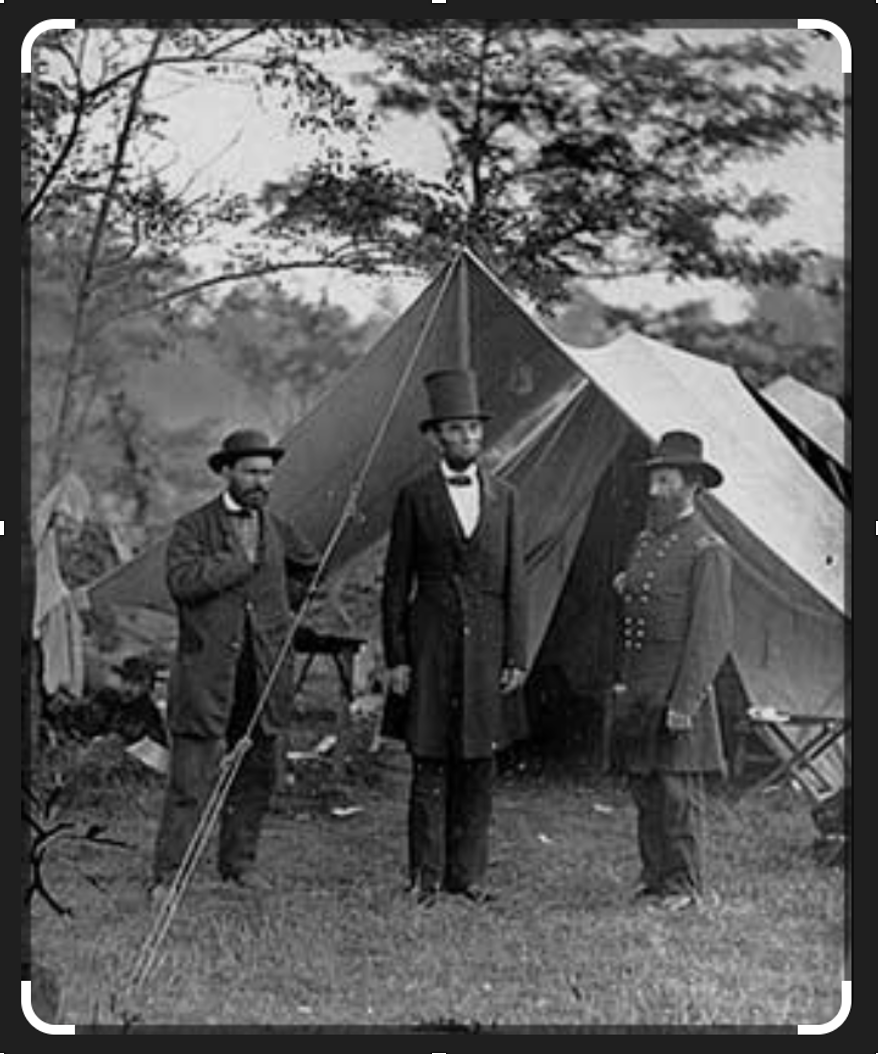
- This photograph depicts President Abraham Lincoln visiting a Union camp in Antietam, Maryland, on October 3, 1862.
- Standing to Lincoln's right is Allan Pinkerton, head of the Union Intelligence Service (precursor to the Secret Service), and to his left is Major General John A. McClernand.
- The image was captured by photographer Alexander Gardner shortly after the Battle of Antietam
- The Gettysburg Address was November 19, 1863
The Gettysburg Address was given November 19, 1863 by President Abraham Lincoln, delivered at the dedication of the Soldiers' National Cemetery in Gettysburg, Pennsylvania, four and a half months after the pivotal Battle of Gettysburg. In just 272 words, Lincoln redefined the Civil War as a struggle for the nation's founding principles of liberty and equality, urging Americans to dedicate themselves to ensuring that "government of the people, by the people, for the people, shall not perish from the earth".Key points of the speech:Context: Given at the cemetery dedication for Union soldiers killed at the Battle of Gettysburg, the speech was meant to consecrate the ground, though Lincoln argued the soldiers had already done so.Core message: Lincoln connected the war to the Declaration of Independence, stating the nation was "conceived in Liberty, and dedicated to the proposition that all men are created equal".Purpose: He framed the war as a test of whether a nation founded on those principles could survive, calling for a "new birth of freedom". Famous closing: The speech concludes with the powerful line, "that government of the people, by the people, for the people, shall not perish from the earth".Length: It was very brief (about two minutes), especially compared to the main speaker, Edward Everett, who spoke for nearly two hours.
The Gettysburg Address"Now we are engaged in a great civil war, testing whether that nation, or any nation so conceived and so dedicated, can long endure. We are met on a great battle-field of that war. We have come to dedicate a portion of that field, as a final resting place for those who here gave their lives that that nation might live. It is altogether fitting and proper that we should do this.But, in a larger sense, we can not dedicate—we can not consecrate—we can not hallow—this ground. The brave men, living and dead, who struggled here, have consecrated it, far above our poor power to add or detract. The world will little note, nor long remember what we say here, but it can never forget what they did here. It is for us the living, rather, to be dedicated here to the unfinished work which they who fought here have thus far so nobly advanced. It is rather for us to be here dedicated to the great task remaining before us—that from these honored dead we take increased devotion to that cause for which they gave the last full measure of devotion—that we here highly resolve that these dead shall not have died in vain—that this nation, under God, shall have a new birth of freedom—and that government of the people, by the people, for the people, shall not perish from the earth."
"A Psalm of Life"BY HENRY WADSWORTH LONGFELLOWWhat The Heart Of The Young Man Said To The Psalmist.Tell me not, in mournful numbers, Life is but an empty dream! For the soul is dead that slumbers, And things are not what they seem.Life is real! Life is earnest! And the grave is not its goal; Dust thou art, to dust returnest, Was not spoken of the soul.Not enjoyment, and not sorrow, Is our destined end or way; But to act, that each to-morrow Find us farther than to-day.Art is long, and Time is fleeting, And our hearts, though stout and brave, Still, like muffled drums, are beating Funeral marches to the grave.In the world’s broad field of battle, In the bivouac of Life, Be not like dumb, driven cattle! Be a hero in the strife!Trust no Future, howe’er pleasant! Let the dead Past bury its dead! Act,— act in the living Present! Heart within, and God o’erhead!Lives of great men all remind us We can make our lives sublime, And, departing, leave behind us Footprints on the sands of time;Footprints, that perhaps another, Sailing o’er life’s solemn main, A forlorn and shipwrecked brother, Seeing, shall take heart again.Let us, then, be up and doing, With a heart for any fate; Still achieving, still pursuing, Learn to labor and to wait.